Tips · GREENSIDE BUNKER · SLOW MOTION
On a good bunker shot, the club never touches the ball.
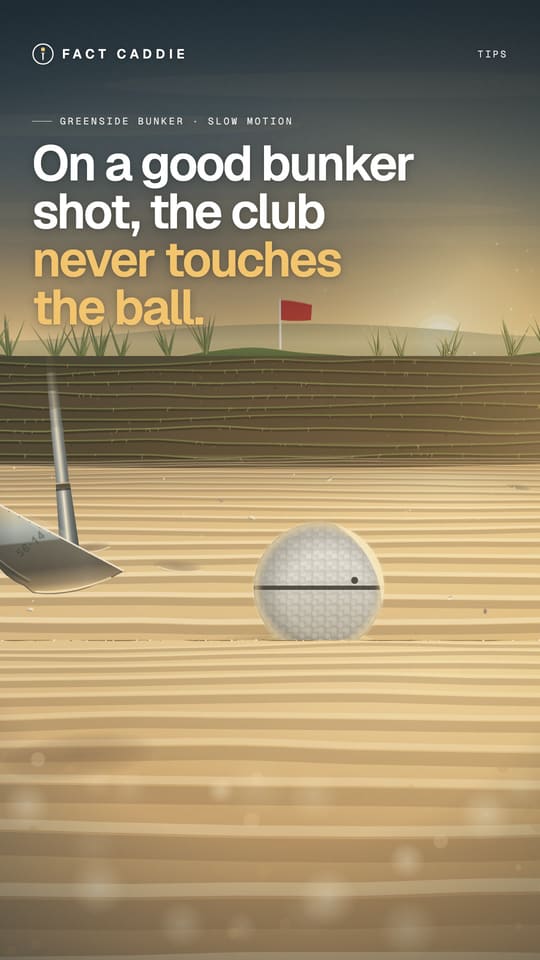
On a good bunker shot the club never touches the ball. It enters the sand an inch or two behind it, and the sand pushes the ball out. Bounce lets the sand wedge skim instead of dig. Gene Sarazen built up a niblick's sole with solder in 1931 and won the 1932 Open with it.
The one to remember
The sand moves the ball. Bounce keeps the club from digging in.
Facts and sources
- On a greenside splash shot the club enters the sand about an inch or two behind the ball (a 2016 Deakin University study puts it at 25 to 50 mm) and slides underneath it. The sand between the clubface and the ball pushes the ball out, and the club never touches it (PGA of America, GOLF.com Top 100 Teachers, ISBS 2016).
- Bounce is the angle between the leading edge and the lowest point of the sole. On a sand wedge the back of the sole sits lower than the leading edge, so the club skims through sand instead of digging in.
- The World Golf Hall of Fame dates Gene Sarazen's idea for the modern sand wedge to 1931, while Howard Hughes was teaching him to fly. At his home in New Port Richey, Florida, Sarazen built up the soles of niblicks with solder.
- He first used it at the 1932 Open at Prince's, Sandwich (8 to 10 June), keeping it out of sight, upside down in his bag. He said later that “the British would have barred it”, but by the time the gallery was talking about it, it was too late. He won by five strokes with a record 283.
- Two weeks later he won the U.S. Open at Fresh Meadow, New York. Sarazen's own wedge is in the USGA Museum: 58.5 degrees of loft, 13.5 degrees of bounce.
Illustration: the slow-motion splash, the flying sand, the cushion of sand under the ball and the cut-away of the bunker are drawn to explain, not measured: the sole first touches the sand 45 mm (about an inch and three quarters) behind the ball, inside the coaching sources' inch or two, and its depth and speed are plausible, not measured. The sand wedge is drawn as a high-bounce model (56 degrees of loft, 14 of bounce, the kind made for soft sand); the club with no bounce digging in is a comparison. The 1931 workshop in Florida, Sarazen at the bench, the niblick on its block and the solder, Prince's in 1932, the walk, the wedge upside down in the bag (its head picked out in gold), the bunker shot, the caddie and the gallery are imagined from the sources, with no likeness intended.
Sources
- Mary Ann Sarazen: Dad didn't invent the sand wedge, but he modernized it · GOLF Magazine (Mary Ann Sarazen, Gene Sarazen's daughter; online at golf.com, as archived by the Internet Archive on 13 December 2019) checked 11 October 2026
- Analysis of greenside bunker shots in golf · Josefa Wivou, Lanka Udawatta and Pubudu Pathirana (School of Engineering, Deakin University), 34th International Conference of Biomechanics in Sports, ISBS Proceedings Archive (published 6 November 2016) checked 11 October 2026
- These 5 Bunker Tips Will Instantly Improve Your Sand Shots · PGA of America, PGA.com (Brendon Elliott, PGA, 15 July 2025) checked 11 October 2026
- How to hit a bunker shot: 5 easy steps to get up-and-down from the sand · GOLF.com (Zephyr Melton, 4 March 2021) checked 11 October 2026
- How to hit a bunker shot: 2 tips for perfect shots from the sand · GOLF.com (Bernie Najar, GOLF Top 100 Teacher, 5 July 2021) checked 11 October 2026
- Ben Crenshaw reveals how to get up and down from any bunker lie · GOLF.com (Ben Crenshaw; one of its timeless tips, republished 12 May 2025) checked 11 October 2026
- Golf Equipment Glossary: What is wedge bounce? · National Club Golfer (Hannah Holden, 10 March 2020) checked 11 October 2026
- Who Invented the Sand Wedge? (The Society Newsletter #52) · The Society of Golf Historians (Connor T. Lewis, 21 January 2025) checked 11 October 2026
- Sand wedge · Wikipedia checked 11 October 2026
- Gene Sarazen · World Golf Hall of Fame checked 11 October 2026
- Gene Sarazen · The Open (The R&A) checked 11 October 2026
- Previous Opens: 67th Open, Prince's 1932 · The Open (The R&A) checked 11 October 2026
- Prince's, England · The Open (The R&A) checked 11 October 2026
- The 67th Open, 1932 Prince's: Sarazen the trailblazer · The Open (The R&A) checked 11 October 2026
- Did you know: Gene Sarazen designed the modern sand wedge with an assist from billionaire Howard Hughes · Golf Digest, via Golf Digest Middle East (30 March 2020) checked 11 October 2026
- Gene Sarazen · Wikipedia checked 11 October 2026
- How learning about your sand wedge can make you a better bunker player · GOLF.com (Mike Perpich, GOLF Top 100 Teacher, 11 May 2021) checked 11 October 2026
- 1932 Open Championship · Wikipedia checked 11 October 2026
- In praise of Gene Sarazen's wedge: One of the greatest clubs of all-time · GOLF.com (Michael Bamberger, 5 March 2019) checked 11 October 2026
The narration is AI-generated. Sources last checked 11 October 2026.
Script
On a good bunker shot, the club never touches the ball. It enters the sand an inch or two behind the ball and slides underneath it. The sand in between does the pushing. The ball floats out on a cushion of sand. On a sand wedge, the back of the sole sits lower than the leading edge. That angle, called bounce, makes the club skim through the sand instead of digging in. The modern sand wedge was Gene Sarazen's idea. In 1931 he built up the sole of a niblick with solder. At the 1932 Open at Prince's, he kept it hidden. He said the British would have banned it. By the time the gallery was talking about it, it was too late. He won by five shots, and two weeks later won the U.S. Open too.